Hemp fabric: how it is made, how it is labelled, and its footprint per kg
By Ketul Patel • • 9 min read
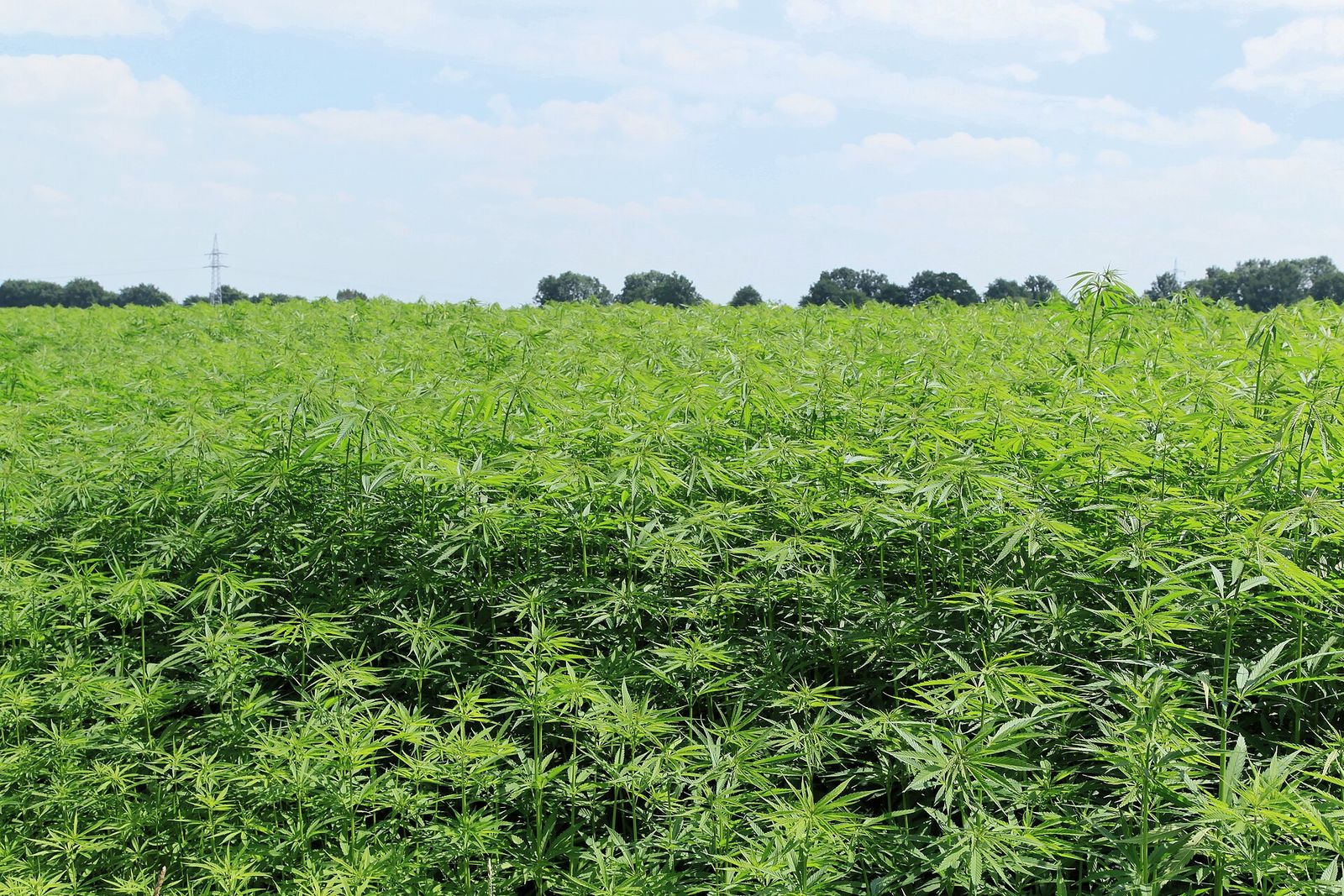
Hemp fabric is cloth made from the long fibres in the stalk of the hemp plant, Cannabis sativa, grown in varieties with very little THC. This guide explains how hemp becomes fabric, what may be called hemp on a label, its carbon footprint per kg, and what a buyer will ask a supplier who sells it.
What is hemp fabric? The short answer
Hemp is a bast fibre. Like flax for linen and jute, the fibre grows in the outer layer of the plant's stem, around a woody core.
It is a niche fibre by volume. Textile Exchange's Materials Market Report 2026 estimates that about 0.4 million tonnes of fibre hemp were grown in 2025, or 0.3% of all fibre made.
The report counts 20 countries that grew fibre hemp, based on FAO data. France grew over a third of the world's hemp fibre, followed by China and the United States.
Hemp fabric is used for shirts, trousers, bags, canvas and home textiles, often blended with cotton. The European Commission's hemp page notes that hemp fibre is very similar to linen.
Europe's hemp area has grown fast. The European Commission reports that the EU grew fibre hemp on 20,540 hectares in 2015 and 33,020 hectares in 2022, a 60% rise.
Output grew faster than area. EU hemp production rose from 97,130 tonnes to 179,020 tonnes over the same years, an 84.3% increase, the Commission says.
France leads. It accounts for more than 60% of EU production, followed by Germany at 17% and the Netherlands at 5%.
In 2024 the EU's common catalogue listed 116 hemp varieties. Farmers who want EU farm payments must use seed of a listed variety.
Outside Europe, hemp rules and data are patchier. Textile Exchange notes that hemp production data are not easily available worldwide and that growing hemp is not yet legal everywhere, though more governments now allow it.
How hemp fabric is made, from stalk to cloth
Hemp fabric begins as straw. Farmers cut the stalks and usually leave them in the field to ret.
Retting lets microbes loosen the fibre from the woody core. A nova-Institute study describes dew retting in the field and water retting under water, each taking two to three weeks.
Next, a decortication or scutching line breaks the stalk and separates the fibre. Most of the straw is not fibre at all.
In nova's typical hemp line, 100 kg of straw gives about 30 kg of fibre, 55 kg of shives (the woody core) and 15 kg of dust and other residues. The shives are sold too, for example as animal bedding.
For apparel, the fibre needs more work. Long fibre can be hackled and spun much like linen, while shorter fibre is often cut and softened so it can run on cotton-spinning machines and be blended.
A hemp field makes several products, and that matters for the footprint. Shives are the largest share by weight, and seed can also be harvested from dual-purpose crops for food or feed.
- GrowingLow-THC hemp, about five months
- RettingDew or water retting, two to three weeks
- DecorticationFibre separated from the woody shives
- Fibre preparationHackled long fibre or softened short fibre
- Yarn and fabricSpun, often blended with cotton, then woven or knitted
What counts as hemp on a label
In the EU, the label name hemp refers to fibre from the bast of Cannabis sativa. Regulation (EU) No 1007/2011 lists it in Annex I as true hemp.
Manila hemp is a different fibre. The same annex names it abaca, a fibre from the leaf sheath of a banana relative, Musa textilis, so it cannot be sold as hemp.
Every fibre in a blend must be named with its share by weight, largest first. A 55% hemp and 45% cotton shirt must say so.
For EU farm payments, a hemp variety must have a THC content below 0.3%, the Commission says. Imports of hemp need a licence, and raw hemp imports may not exceed 0.3% THC. Rules differ by country, so check the law where the crop is grown. This is general information, not legal advice.
How hemp fabric feels and where it is used
Hemp fabric is known for being strong and firm. The fibres are long and stiff, so new cloth can feel crisp, much like linen. Many makers say it softens with washing and wear.
It is often blended to change the feel. Hemp-cotton is the most common mix in apparel, and hemp is also mixed with linen, silk, lyocell or a little elastane for stretch.
Typical products are shirts, trousers, workwear, bags, canvas, aprons, curtains and table linen. Heavier hemp canvas is used where strength matters, such as tote bags and shoe uppers.
The weave and finish matter as much as the fibre. Enzyme washing, a looser weave or a finer yarn can make hemp feel far softer than the stiff cloth many people picture.
For a footprint, each of these choices shows up in the numbers. A blend changes the fibre factors, and a heavy wash or finish adds factory energy and water.
Hemp fabric carbon footprint per kg
Our calculator uses 0.406 kg CO₂e per kg of hemp fibre. The figure is from the nova-Institute study, for hemp grown in the Netherlands with mineral fertiliser, cradle to the gate of a non-woven maker in Germany.
It uses mass allocation. With economic allocation the same scenario gives 0.846 kg CO₂e per kg, about twice as much, so always state which one you used.
When one process makes several products, the emissions have to be shared between them. Mass allocation gives the fibre a smaller share, because the shives weigh more; economic allocation gives it more, because fibre is the most valuable output. Our guide to allocating factory energy to products explains the idea.
It is a figure for technical fibre. nova studied hemp for composites and insulation, so the extra steps that make textile-grade fibre and yarn are not in it. Treat it as a low case for apparel hemp.
The chart shows per-kg factors from our library. Each has its own source and boundary on its material page, such as hemp, linen and cotton, so read them as scale, not a ranking.
What drives the hemp footprint: fertiliser
Fertiliser is the biggest single source. In nova's main scenario, making the fertiliser and the nitrous oxide it releases from the soil add up to 232 of the 406 kg CO₂e per tonne of fibre.
Field work and the fibre plant come next. Field operations add 37 kg, and the processing plant adds 60 kg per tonne.
Transport is small when growing and processing are both in Europe. In nova's case it adds 63 kg per tonne in total.
The study found that using pig slurry instead of mineral fertiliser cut the result to 364 kg per tonne. Harvesting seed as well as straw cut the economic result most, from 846 to 530 kg, because the seed is valuable.
Carbon stored in hemp is reported separately
Hemp takes up CO₂ as it grows, and some of that carbon stays in the fibre. The European Commission says a hectare of hemp takes up 9 to 15 tonnes of CO₂.
That uptake is not subtracted from a product footprint. ISO 14067 asks for biogenic carbon to be shown on its own, because it returns to the air when the fibre rots or burns. Our glossary entry on biogenic carbon explains why.
So a claim that hemp fabric is “carbon negative” needs care. The fossil emissions from growing and processing are real, and the stored carbon is only held for the life of the product.
Worked example: the fibre in a hemp-cotton shirt
Take a 200 g shirt made of 55% hemp and 45% cotton. That is 110 g of hemp and 90 g of cotton. The shirt is our example.
The hemp line is 0.11 kg × 0.406 kg CO₂e/kg = 0.045 kg CO₂e. With economic allocation it would be 0.093 kg.
The cotton line is 0.09 kg × 4.17 kg CO₂e/kg = 0.375 kg CO₂e, using our factor for conventional cotton grown in India. So the cotton is most of the fibre total here.
The factory then adds its share. Spinning, weaving, dyeing and sewing are where most of a shirt's footprint usually sits, as our guide to the carbon footprint of a T-shirt shows.
Add fibre losses as well. If 10% of the fibre bought never reaches the shirt, you buy about 0.122 kg of hemp and 0.1 kg of cotton, and the fibre lines rise to about 0.050 and 0.417 kg CO₂e.
What buyers check when you sell hemp fabric
Buyers want to know where the hemp was grown and how it was processed. Field-retted European hemp and fibre from another region or route can carry different figures.
Expect a question on the blend. Many hemp fabrics are hemp-cotton, so the cotton share often decides the fibre total, as the example shows.
Common mistakes are easy to avoid. Using the technical-fibre figure without saying so, leaving out the allocation method, and netting field CO₂ uptake against the total all weaken a footprint.
Watch your claim words. Do not call hemp fabric “eco-friendly” on its own; give figures with their sources, as our guide to the EU environmental claims rules explains.
- Name the country where the hemp was grown
- Keep the fibre or yarn supplier's invoices with each order
- State the factor, its source and its allocation method
- Say whether the factor covers textile-grade processing
- List every fibre in the blend by weight, largest first
- Include fibre lost in spinning and cutting
- Report any biogenic carbon as a separate line
What to do next
Start with the bill of materials. List the hemp and other fibre weights per product, and the yarn supplier for each.
Ask your yarn supplier for its own footprint per kg, with the year and method. That replaces the technical-fibre factor and closes the gap for textile-grade steps.
Then run the product through our product carbon footprint calculator. It adds your factory energy, packaging and transport. For a bast fibre side by side with cotton, see our linen vs cotton comparison, and for an animal fibre, our guide to wool fabric.
Sources and further reading
de Beus, Carus and Barth (2019), Carbon Footprint and Sustainability of Different Natural Fibres for Biocomposites and Insulation Material, nova-Institut: PDF
Textile Exchange, Materials Market Report 2026: textileexchange.org
European Commission, Agriculture and rural development: Hemp: agriculture.ec.europa.eu
Regulation (EU) No 1007/2011 on textile fibre names: EUR-Lex
Our emission factors and their sources: methodology
Questions
What is hemp fabric made from?
Hemp fabric is made from the bast fibre in the stalk of low-THC Cannabis sativa. The fibre is loosened by retting, separated from the woody core, then spun and woven or knitted.
Is hemp fabric the same as Manila hemp?
No. Manila hemp is abaca, a leaf fibre from Musa textilis. EU fibre-name rules list it separately from true hemp.
What is the carbon footprint of hemp fabric?
For hemp fibre, the nova-Institute study gives 0.406 kg CO₂e per kg with mass allocation and 0.846 kg with economic allocation, cradle to gate. Fabric is higher, because spinning, weaving and dyeing add energy.
Is hemp fabric better than cotton?
We do not rank fibres. Per kg, our library holds 0.406 kg CO₂e for hemp fibre and 4.17 for conventional cotton grown in India, but the boundaries differ and the factory and use phase often decide the product total.
Can hemp fabric get you high?
No. Fibre hemp is grown from low-THC varieties; EU farm-payment rules require varieties below 0.3% THC. The fabric is made from the stalk fibre, not the flowers.
Does hemp fabric soften over time?
Hemp fibre is long and stiff, so new fabric can feel firm. The yarn, the weave, the finish and any cotton blend decide how soft it is, so test the fabric you plan to use.
Who grows the most hemp?
France grew over a third of the world's hemp fibre, according to Textile Exchange's 2026 report. In the EU, France accounts for more than 60% of production, the European Commission says.
Is hemp fabric a natural fibre?
Yes. Hemp is a plant fibre taken from the stem, like flax and jute, and spun without being dissolved. Bamboo or hemp sold as viscose is different: that fibre is dissolved pulp, a man-made cellulose fibre.
Keep reading
 Basics • MaterialsWool fabric: how it is made, its types, its labels and its carbon footprintby Ketul Patel • 16 Nov 2026 • 9 min read
 Basics • MaterialsWhat is modal fabric? How it is made, how it is labelled, and its footprintby Ketul Patel • 14 Nov 2026 • 8 min read
 Basics • DataEmission factors explained: where the numbers come from and how to chooseby Ketul Patel • 12 Nov 2026 • 9 min read
 Methods & standards • MethodAllocation in product carbon footprints: sharing factory energyby Ketul Patel • 12 Nov 2026 • 9 min read
 Basics • ApparelHow to calculate the carbon footprint of a T-shirt, step by stepby Ketul Patel • 12 Nov 2026 • 9 min read