What is recycled polyester? rPET, how it is made and what it saves
By Ketul Patel • • Updated • 9 min read
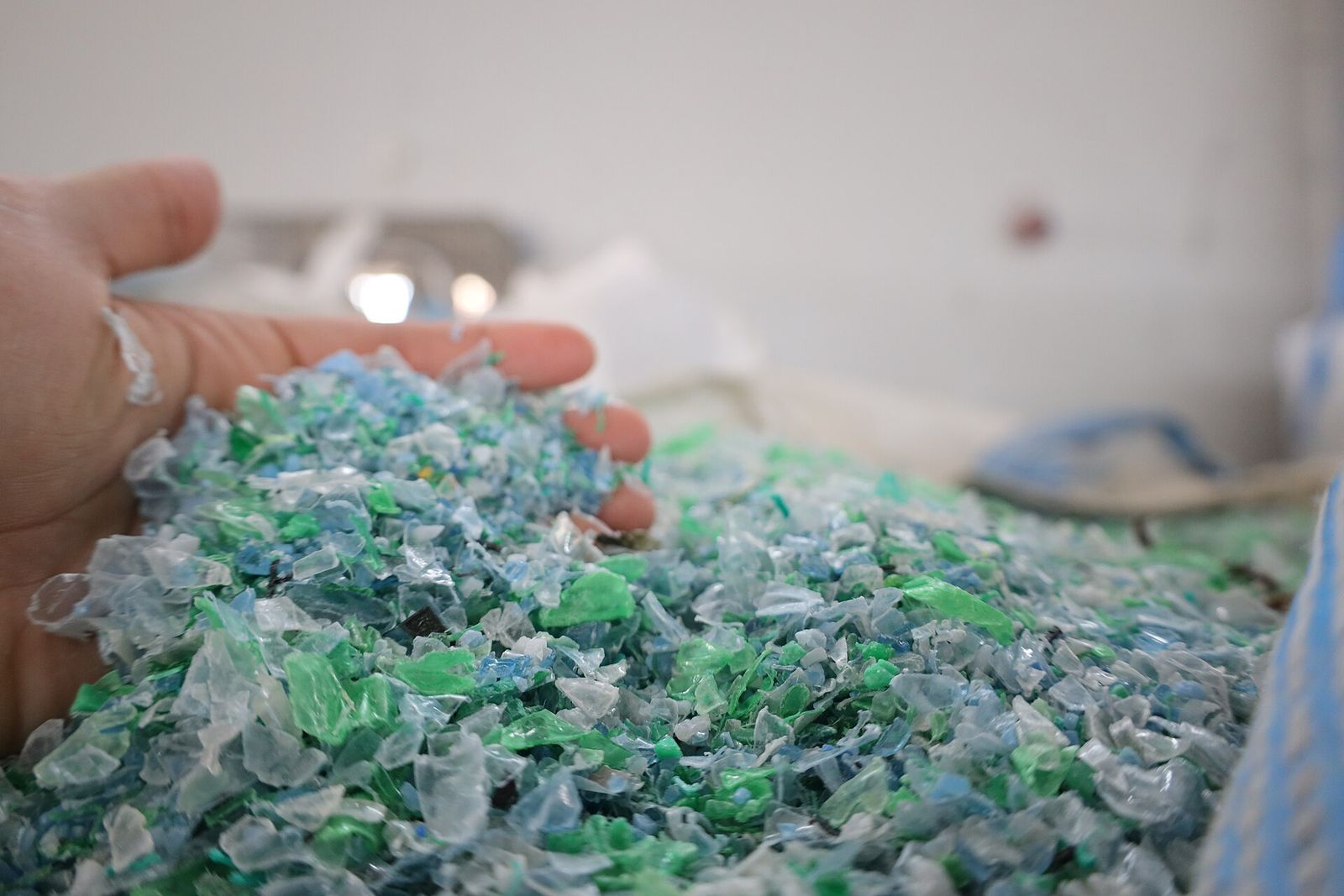
What is recycled polyester? It is polyester fibre made from PET plastic that has already been used, mostly drinks bottles, instead of from new oil-based chemicals. On spec sheets it is often written as rPET. This guide covers where it comes from, how it is made, what it saves per kg and the papers a buyer will expect.
What is recycled polyester, exactly?
Recycled polyester is the same polymer as ordinary polyester: polyethylene terephthalate, or PET. Only the source changes.
A 2021 report by the Dutch environmental assessment agency PBL and the research body TNO explains the link. The textile trade uses "polyester" for fibre-grade PET, while bottles use bottle-grade PET.
The recycled input can be pre-consumer, such as factory scrap, or post-consumer, such as used bottles. Textile Exchange's recycled standards accept both, provided the material meets the ISO definition of recycled.
Always read the percentage on a spec sheet. A fabric with 30% recycled fibre is still 70% virgin polyester, and its footprint follows that mix.
- Post-consumer: material from products that reached a user, such as drinks bottles or worn garments.
- Pre-consumer: waste from a factory process, such as spinning scrap or fabric offcuts, that never reached a user.
- Names you will see: rPET, recycled PET, recycled polyester, or a trade name from the fibre maker.
Where recycled polyester comes from: the numbers
Almost all of it comes from plastic bottles. Textile Exchange's Materials Market Report 2026 puts recycled polyester output at about 9.7 million tonnes in 2025, and 97% of it came from bottles.
Total polyester output was 82.5 million tonnes in 2025, or 59% of all fibre made worldwide. By our arithmetic, recycled polyester was about 12% of all polyester.
Textile-to-textile recycling is still small. Across all fibres, it rose from 0.61% of production in 2021 to 0.76% in 2025, the same report says.
So a recycled polyester T-shirt today is very likely to be a former bottle, not a former shirt.
Recycled output is growing, but virgin output is growing faster. The 2025 edition reported that recycled polyester's share of all polyester fell from 12.5% in 2023 to 12% in 2024.
The same report found recycled fibres of all kinds were 7.6% of global fibre in 2024. Recycled polyester from bottles alone was 6.9%.
How recycled polyester is made from bottles
Most recycled polyester is made by mechanical recycling. Bottles are collected, sorted, washed and chipped into small flakes, then melted and made into fibre.
The PBL report describes a Dutch site that washes and chips post-consumer PET into flakes, which are then shipped to another plant to be turned into fibre-grade PET.
Each step uses electricity or heat. That is why recycled polyester still has a footprint, even though no new oil goes into the polymer.
Supply depends on bottle collection. PBL reports that only 48.3% of PET packaging in Europe was recycled in 2016. The Dutch deposit scheme collected about 95% of bottles over 0.5 litres.
Smaller bottles sat outside that scheme until July 2021, and only 58% of them were recycled.
- Collect and sortUsed PET bottles, by colour and type
- Wash and chipCleaned and cut into rPET flakes
- MeltFlakes melted, often with virgin PET
- SpinMade into filament or staple fibre
- Yarn and fabricSpun, knitted or woven, then dyed
Why bottles step down to fibre
Bottle PET usually becomes fibre, not new bottles, because recycling shortens its polymer chains. The measure for chain length is called intrinsic viscosity (IV).
PBL gives typical IV ranges: 0.40 to 0.70 dL/g for fibre-grade PET and 0.70 to 0.85 for bottle-grade. Mechanical recycling lowers IV, so a bottle drops neatly into the fibre range.
Colour additives and mixed materials add to the problem. They are hard to remove, and contamination lowers quality and raises sorting costs.
PBL concludes that, because quality degrades, mechanical recycling cannot be a fully circular loop.
Mechanical vs chemical recycling
There are two routes from waste PET to new polymer. Mechanical recycling keeps the polymer chains; chemical recycling breaks them down and rebuilds them.
In chemical recycling, PET is broken down into a building block called BHET, purified and polymerised again. PBL notes that this can make new PET without adding virgin material.
PBL cites a life-cycle study by CE Delft on both routes. Chemical recycling emitted slightly more than mechanical, mainly because making recycled BHET uses more energy. Both were far below virgin PET.
For a garment maker, the route rarely shows on a spec sheet. Ask your yarn supplier which route its fibre took, and whether its footprint figure covers that route.
The same study looked at repeated cycles. Over several loops, the chemical route gained an edge, because it loses less material and keeps quality higher.
The figures below are for PET polymer in that one study, not for fibre. PBL warns that its assumptions may not match a given plant.
How much carbon does recycled polyester save?
Per kg of fibre, our calculator uses 2.21 kg CO2e for recycled polyester and 3.86 kg CO2e for virgin polyester. Both come from the UK government's DESNZ 2025 conversion factors. The recycled factor is about 43% lower.
The gap rests on a method choice. The DESNZ 2025 methodology paper says factors for secondary materials cover sorting, processing, manufacture and transport. The emissions of making the original PET stay with the bottle's first life.
DESNZ also says the user of recycled material receives the benefit of recycling in its Scope 3 figure. It adds that these factors are for use when you lack data specific to your goods.
Read how emission factors work before you compare figures from different databases, because each may draw the line differently.
- 100% recycled, documented: use 2.21 kg CO2e per kg for the fibre.
- Blend: weight each share. A 50/50 recycled and virgin blend is 0.5 x 2.21 + 0.5 x 3.86, about 3.04.
- Recycled claim without proof: use the virgin factor until the certificate arrives.
- Recycler's own figure: use it in place of the library factor, and name its method and year.
Worked example: switching a T-shirt to recycled polyester
Take a T-shirt with 0.2 kg of polyester fibre. With virgin fibre, the fibre stage is 0.2 x 3.86, or about 0.77 kg CO2e.
With documented recycled fibre it is 0.2 x 2.21, or about 0.44 kg CO2e. The switch saves about 0.33 kg CO2e per shirt on fibre.
A 50/50 blend sits in between. At about 3.04 kg CO2e per kg, the same 0.2 kg gives roughly 0.61 kg CO2e.
Now set that against the whole garment. Fibre is only the raw materials stage. A T-shirt's whole-life footprint also counts production, packaging, transport, washing and disposal.
So fibre choice matters, but it is one lever. Production is often the largest stage for a garment, and it covers spinning, knitting, dyeing, finishing and sewing.
Those steps are the same for recycled and virgin polyester. Cleaner factory energy, such as solar electricity, cuts them whichever fibre you use.
How to prove recycled content: RCS and GRS
A buyer will accept the lower factor only for recycled content you can prove. The usual proof is third-party certification to Textile Exchange's Recycled Claim Standard (RCS) or Global Recycled Standard (GRS).
Both check recycled content and the chain of custody from recycler to final product. The GRS adds social, environmental and chemical requirements for processing sites.
The GRS can be used business-to-business for products with at least 20% recycled content. A consumer-facing GRS label needs at least 50%. Note that GRS certification does not automatically include RCS.
Textile Exchange is merging its standards into a new Materials Matter Standard. The dates below come from its RCS and GRS page.
- 12 Dec 2025Materials Matter Standard criteria releasedTextile Exchange's unified standard
- 31 Dec 2026Standard becomes effectiveSites can start auditing to it
- 31 Dec 2027Standard becomes mandatoryNext audits must use the new standard to keep certification
- RCS: checks recycled content and chain of custody only.
- GRS: adds social, environmental and chemical rules for processing sites; 20% minimum for business use, 50% for consumer labels.
- Both: audited by a third-party certification body at each stage of the supply chain.
What buyers check, and common mix-ups
Buyers check the paperwork first and the factor second. Most confusion comes from mixing up the source, the polymer and the proof.
If someone asks you what is recycled polyester, the short answer is: the same PET, from a different source, with documents to prove it.
Expect questions beyond carbon as well. Some buyers ask about microfibre shedding, because a recycled polyester fabric sheds like any other polyester.
- RCS or GRS certificate covering the yarn or fabric site
- Recycled share by weight from the bill of materials
- Source: pre- or post-consumer, bottle or textile
- Factor used: recycler's own figure or a named, dated library factor
- One footprint per product with its boundary
- "It is made from old clothes." Usually not. In 2025, 97% of recycled polyester came from bottles.
- "It has no footprint." It does. Sorting, washing, melting and spinning all use energy.
- "It does not shed." It is still polyester. A 2019 wash study in Scientific Reports included a blouse with 65% recycled polyester among the garments that shed microfibres.
- "Any recycled share can go on the label." Not under the GRS, where consumer labels need at least 50%.
- "Chemical recycling is now the norm." PBL called it early stage in 2021. Ask which route your fibre came through.
What to do next
Apply the recycled factor only to the share backed by documents. If your recycler gives you its own measured figure, use it and say so; that raises your primary data share.
If you buy fabric rather than yarn, the certificate you need is the one covering your fabric supplier's site. Ask for it with each order and keep it with the bill of materials.
Check it again as the standards change. From 31 December 2027, sites must pass their next audit under the new Materials Matter Standard to keep certification.
When a buyer asks, answer with one figure per product. Our guide on how to answer a customer carbon footprint request shows the format.
- 1Collect the proofRCS or GRS certificate and recycled share
- 2Screen the styleRun a free estimate from a product link
- 3Swap in real dataUse the recycler's own figure if it has one
- 4Build the footprintAdd mill energy, trims and packaging
- 5Share itSend a PACT data file, not a slogan
- Quick check: try our free footprint estimate on one style.
- Full figure: build it with the product carbon footprint calculator.
- Data file: share it as a PACT data file.
Sources and further reading
Every figure above was read at these primary sources in November 2026.
- Materials Market Report 2026: Textile Exchange
- Recycled Claim Standard and Global Recycled Standard: Textile Exchange
- Tran and West (2021), Decarbonisation options for the Dutch bottle-grade PET industry: PBL and TNO
- Greenhouse gas reporting: conversion factors 2025, methodology paper: UK DESNZ
- De Falco et al. (2019), The contribution of washing processes of synthetic clothes to microplastic pollution: Scientific Reports via PMC
Questions
Is recycled polyester the same as rPET?
Yes. rPET means recycled polyethylene terephthalate, the polymer polyester fibre is made of.
Is recycled polyester made from bottles?
Mostly. Textile Exchange reports that 97% of the recycled polyester made in 2025 came from plastic bottles.
Is recycled polyester still plastic?
Yes. Recycling changes the source of the PET, not the polymer, so a recycled polyester fabric is still a plastic fabric.
How much lower is the footprint of recycled polyester?
In the DESNZ 2025 factors our calculator uses, it is 2.21 kg CO2e per kg against 3.86 for virgin polyester, about 43% lower. The gap relies on leaving the original PET's emissions with its first use.
Is recycled polyester lower quality than virgin?
Mechanical recycling shortens the polymer chains, which is why bottles usually become fibre. Chemical recycling can make new PET without virgin input, but PBL called it early stage in 2021.
Can old polyester clothes be recycled into new ones?
Some can, but little is today. Textile-to-textile recycling made up 0.76% of all fibre produced in 2025.
Why is most recycled polyester made from bottles?
Bottles are collected at scale, for example through deposit schemes. The EEA notes that recycling synthetic textiles is especially hard, for both technical and economic reasons.
How do I prove recycled content to a buyer?
Use third-party certification such as Textile Exchange's RCS or GRS, which covers recycled content and chain of custody. Keep the certificate and the recycled share by weight for each product.
Keep reading
 Basics • MaterialsIs polyester plastic? Yes. What that means for makers and buyersby Ketul Patel • 13 Nov 2026 • 9 min read
 Basics • DataEmission factors explained: where the numbers come from and how to chooseby Ketul Patel • 12 Nov 2026 • 9 min read
 Methods & standards • DataPrimary data share: primary vs secondary data in a product footprintby Ketul Patel • 12 Nov 2026 • 9 min read
 Basics • ApparelHow to calculate the carbon footprint of a T-shirt, step by stepby Ketul Patel • 12 Nov 2026 • 9 min read
 Basics • MaterialsWhat is vegan leather? Types, layers, plastic content and footprintby Ketul Patel • 13 Nov 2026 • 9 min read