Carbon footprint meaning: a plain-English guide with examples
By Ketul Patel • • Updated • 9 min read

The carbon footprint meaning, in plain words, is the total greenhouse gas released because of something: a person's year, a company's work or a single product. It is counted in one unit, kilograms or tonnes of CO2e. This guide explains the gases, the unit, the three kinds of footprint and how a product figure is built, with a worked example for a cotton T-shirt.
What does carbon footprint mean?
A carbon footprint is the amount of greenhouse gas that something causes, added up and shown as one number. That something can be you, a business, an event or a product.
The word footprint tells you it is a total inside a boundary. You choose the boundary first, such as one year of a company's work or one T-shirt from farm to bin. Then you add up every source inside it.
The word carbon is shorthand. A footprint counts several gases, not only carbon dioxide. Each gas is converted to the same unit before it is added.
The same idea works at any scale. A country's footprint, a factory's footprint and a shirt's footprint all follow it. Only the boundary and the size of the number change.
For a manufacturer, the word usually means one of two things. Either the factory's yearly total, or the figure for one product it sells. Knowing which one is wanted saves a lot of rework.
So every footprint has three parts: a boundary, a list of activities inside it, and a total in CO2e. If any of the three is missing, the number cannot be compared with anything.
- ActivityFuel burned, power used, fibre grown
- Gases releasedCO₂, methane, nitrous oxide and others
- ConvertWeight each gas by its warming effect
- Add upOne total in kg or t CO₂e
Which gases a carbon footprint counts
Most footprints count the seven gases covered by the Kyoto Protocol. The GHG Protocol corporate standard lists them for company inventories.
In a factory, carbon dioxide comes from burning coal, gas, diesel or biomass, and from power stations that make grid electricity. That is why fuel and power bills sit at the heart of every factory footprint.
The other six gases are released in much smaller amounts, but some are far stronger per kilogram. The next section shows how that is handled.
A footprint does not need a separate line for every gas. Most emission factors already combine all the gases for one activity into a single CO2e figure.
The unit: what kg CO2e means
Carbon footprints are given in kilograms or tonnes of CO2e, short for carbon dioxide equivalent. It lets you add different gases together as if they were all CO2.
Each gas has a global warming potential (GWP). It compares the gas's warming effect with CO2 over a set period, usually 100 years. CO2 is the reference, so its GWP is 1.
The US EPA lists methane at 27 to 30 and nitrous oxide at 273 over 100 years. These values come from the IPCC's Sixth Assessment Report, published in 2021.
So releasing 1 kg of nitrous oxide counts as 273 kg CO2e. Releasing 1 kg of CO2 counts as 1 kg CO2e. Adding everything in CO2e gives one total you can compare.
Small factors add up. One kilogram of a strong gas can matter as much as hundreds of kilograms of CO2, so small releases of those gases still count.
Products are usually given in kilograms of CO2e per item. Companies and countries usually use tonnes per year. One tonne is 1,000 kg.
The three kinds of carbon footprint
There are three common kinds: a personal footprint, a corporate footprint and a product footprint. They use the same unit but draw the boundary around different things.
A personal footprint covers one person's year: travel, home energy, food and things bought. It is mostly used for awareness and personal choices.
Personal calculators differ a lot in what they include, so two results are rarely comparable. Treat them as a rough guide, not a measurement.
A corporate footprint covers a company's year, split into three scopes. Scope 1 is direct emissions from sources the company owns or controls, such as boiler fuel. Scope 2 comes from bought electricity, steam, heat or cooling (PIB).
Scope 3 is everything else in the value chain, from bought fabric to customers washing the clothes.
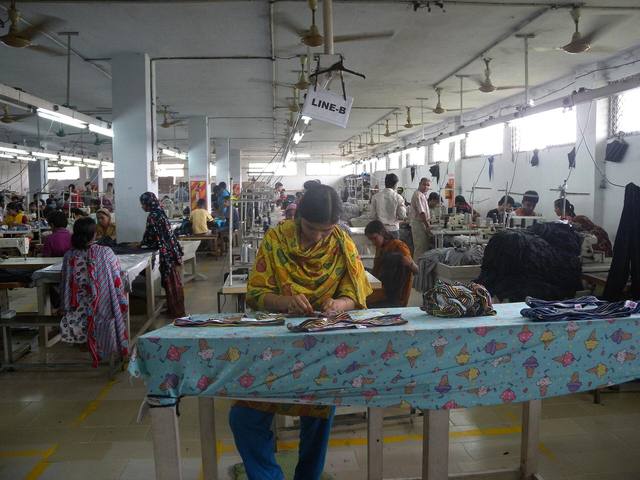
For a garment factory, Scope 1 is the boiler and the diesel generator. Scope 2 is the grid power for sewing lines and lights. Scope 3 is mostly the fabric, trims and packaging it buys.
A product footprint covers one item across its life, from raw materials to disposal. A product's footprint becomes part of its buyer's Scope 3. That is why brands now ask suppliers for product figures.
Carbon footprint meaning for a product: a T-shirt example
For a product, the carbon footprint meaning is the CO2e caused by making, moving, using and disposing of one unit. A T-shirt shows how the stages add up.
The stages are raw materials, production, packaging, transport, use and end of life. Raw materials means the fibre itself. Production covers spinning, knitting, dyeing and sewing. Use is mostly washing and drying at home.
For many garments, production is the largest stage, because spinning, dyeing and finishing run on electricity and heat. Washing and drying over the garment's life can add a lot too. Packaging and end of life complete the total.
This split tells a factory where to look first. If production is the largest stage, electricity and steam in spinning, dyeing and sewing matter more than the shipping carton.
The international standard for this kind of figure is ISO 14067. It covers one impact category only, climate change, and it leaves carbon offsetting outside its scope.
How a product's carbon footprint is worked out
A product footprint is worked out by listing every activity in the product's life, measuring each one, and multiplying it by an emission factor. Then you add the results.
Activity data is the measured amount, such as kilograms of fabric or kilowatt-hours of electricity. An emission factor converts it to CO2e. Our guide to emission factors explains where they come from.
Here is one line from a cotton T-shirt. A shirt with 0.20 kg of cotton, at the 4.17 kg CO2e per kg our calculator uses for conventional cotton, gives about 0.83 kg CO2e for the fibre.
Real footprints use the fibre bought, including cutting losses, so the figure is a little higher. For the full method, read how to calculate a product carbon footprint.
- 1Set the unitOne garment, one pair of shoes, one box.
- 2Set the boundaryTo the factory gate, or the whole life.
- 3Collect activity dataMaterials, energy, transport and waste for that unit.
- 4Apply factorsMultiply each amount by its CO₂e factor.
- 5Add and reportTotal the lines and state the method and sources.
Why footprints vary between products
Footprints vary a lot between products, mostly with weight, material and how much energy the factory uses.
Heavier items with more processing tend to sit higher. Garments that are washed at home carry a use stage. Shoes, bags and packaging have little or none, so materials and production take most of the total.
The spread inside one product type can be wide too. Fabric weight, fibre blend and finishing all move the result, so a figure for one product does not stand for the whole type.
That is why a footprint built on one factory's own data is worth more than an average for the product type.
Why the material changes the number
Each material carries its own footprint per kilogram, so fibre choice and garment weight both move the total. The factors below are the ones our calculator uses.
Conventional cotton is 4.17 kg CO2e per kg and organic cotton 1.46, both from Textile Exchange's 2026 cotton study. Virgin polyester is 3.86 and recycled polyester 2.21, from UK government factors for 2025.
Some factors are less settled. We mark viscose (5.30) and PU synthetic leather (11.7) as contested, because published studies disagree.
The material is only part of the story. Organic cotton has a lower factor than conventional cotton, but factory energy is the same for both, and it is often the larger stage.
Weight works the same way. A 250 g garment needs about a quarter more fibre than a 200 g one, so the fibre line grows by a quarter too.
Our emission factors page lists each factor with its source and status.
Common mix-ups about carbon footprints
The most common mix-up is treating a footprint as a verdict. A footprint is a measurement; it does not by itself show that anything is low or high.
Other mix-ups are easy to avoid once you know the meaning of the term.
- Footprint vs emissions: emissions come from one source. A footprint adds up all sources inside a boundary.
- Footprint vs LCA: a footprint covers climate only, while an LCA can also cover water, land and other impacts. See carbon footprint vs life cycle assessment.
- Total vs per unit: a company total in tonnes cannot be compared with a product figure in kilograms per item.
- CO2 vs CO2e: CO2 is one gas; CO2e is all the gases in one unit.
- Gate vs grave: a figure that stops at the factory gate leaves out use and disposal, so it is smaller.
- Average vs your own: a screening estimate uses average data. A figure on your own bills and bills of materials can be higher or lower.
What buyers mean when they ask for your carbon footprint
When a brand asks a supplier for its carbon footprint, it usually wants a product figure in kg CO2e per item, not a company total. It needs the number for its own Scope 3.
Ask three questions before you reply: which product, which boundary, and which standard. For a garment, use and disposal can be a large part of the whole-life figure, so the boundary matters.
Then say what data you used. A first estimate built from averages is useful for spotting the largest sources. A buyer may later ask for a figure on your own energy and material records.
Then start small. Get a free screening estimate from a product link on /analyze. When you need figures on your own factory data, our product carbon footprint calculator builds them to ISO 14067.
- Confirm it is a product figure, not a company total
- State the unit: kg CO₂e per item
- State the boundary: to the gate or whole life
- Name the standard, such as ISO 14067
- List your emission factors and their sources
- Say which data is your own and which is average
- Date the figure and update it when inputs change
Sources and further reading
- GHG Protocol Corporate Standard (seven gases): GHG Protocol
- Global warming potentials (IPCC AR6 values): US EPA
- ISO 14067:2018, carbon footprint of products: ISO
- Scope 1 and Scope 2 definitions in an Indian context: PIB backgrounder, 12 July 2026
Questions
What is the simple meaning of carbon footprint?
It is the total greenhouse gas caused by a person, organisation or product, given in kilograms or tonnes of CO2e. The total includes several gases, not only carbon dioxide.
What is a carbon footprint example?
A cotton T-shirt is a good example. Its footprint adds up the fibre, factory energy, packaging, transport, washing and disposal. The fibre line alone, for 0.20 kg of conventional cotton, is about 0.83 kg CO2e.
What are the three types of carbon footprint?
The common three are personal, corporate and product footprints. They use the same CO2e unit but draw the boundary around a person, a company or one item.
Why is it called a carbon footprint if it includes other gases?
Each gas is converted into carbon dioxide equivalent using its global warming potential. The total is shown as if it were all CO2, so carbon became the short name.
What is the unit of carbon footprint?
Kilograms or tonnes of CO2e. Products usually use kilograms per item, and companies usually use tonnes per year.
Is a carbon footprint the same as carbon emissions?
Not quite. Emissions come from one source, while a footprint adds up all the emissions inside a boundary, such as one product's life.
Which standard is used for a product carbon footprint?
ISO 14067:2018. It covers climate change only and builds on the life cycle assessment standards ISO 14040 and ISO 14044.
Does buying carbon offsets reduce a product's footprint?
No. ISO 14067 keeps offsetting outside its scope, so the measured footprint stays the same and any offsets are reported separately.
Keep reading
 Basics • Product footprintsWhat is a product carbon footprint? The complete PCF guideby Ketul Patel • 12 Nov 2026 • 12 min read
 Methods & standards • MethodHow to calculate a product carbon footprint, step by stepby Ketul Patel • 12 Nov 2026 • 9 min read
 Basics • DataEmission factors explained: where the numbers come from and how to chooseby Ketul Patel • 12 Nov 2026 • 9 min read
 Basics • LCACarbon footprint vs LCA: what is the difference and which do you need?by Ketul Patel • 12 Nov 2026 • 9 min read
 Basics • BoundariesCradle to gate vs cradle to grave: which boundary does your buyer want?by Ketul Patel • 12 Nov 2026 • 9 min read