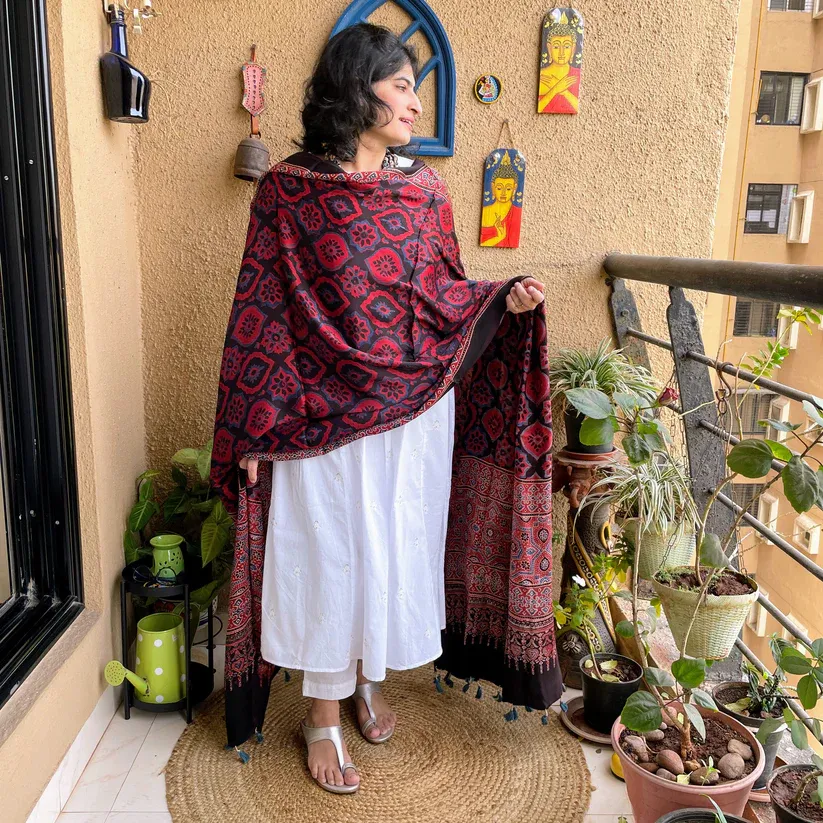
Rust Ajrakh silk dupatta
4.28kg CO₂eEstimate · medium confidence
The median scarf in our catalogue has a carbon footprint of 11.3 kg CO₂e over its whole life, from growing or making the materials to disposal. Half of the 290 scarves we have footprinted, from 24 brands, fall between 4.51 and 18.1 kg CO₂e.
In the typical split, raw materials makes up about 67% of the total, followed by production at about 19%. The split shows where a maker's own data changes the result most: replacing published averages for the largest stages with your own figures moves the footprint far more than refining the small ones.
The split is the median share of each stage across the catalogue's scarves, rescaled to add up to 100%. Read cradle to gate versus cradle to grave for what each stage covers.
The main material is the biggest single choice in a scarf's raw-material footprint. These are the main materials of the scarves in our catalogue, by share of products:
For each product, our calculator tests common changes and reports the one with the largest saving. For scarves, the changes that come out on top most often are:
Share of scarves for which each change gives the largest saving.




Each product's footprint is a screening estimate: we read the materials and weight from the product listing, apply emission factors from cited public sources, and follow the ISO 14067 method with every source shown. Without the maker's own energy and supplier data, these are typical values, not measurements of a particular factory.
To footprint your own scarf, start with a free estimate from a product link, or enter your own factory data. See our methodology for the method and sources.
Across 290 scarves in our catalogue, the median footprint is 11.3 kg CO₂e per item over its whole life, and half fall between 4.51 and 18.1 kg CO₂e. These are screening estimates from product listings; your own product's figure depends on its materials, weight and factory.
In the typical split, raw materials is the largest stage at about 67% of the total, followed by production at about 19%.
Counting only raw materials, production, inbound transport and packaging, up to the factory gate, the median is 9.86 kg CO₂e per item. Buyers often ask for this figure for their Scope 3 inventory.
The change our calculator most often finds with the largest saving for scarves is “run the factory on solar electricity”. The best change for your product depends on your own materials and energy.
Use them to see the size of the footprint and where it comes from. For a figure to send a buyer, footprint your own product with your materials, weight and factory energy, so the result describes what you make.