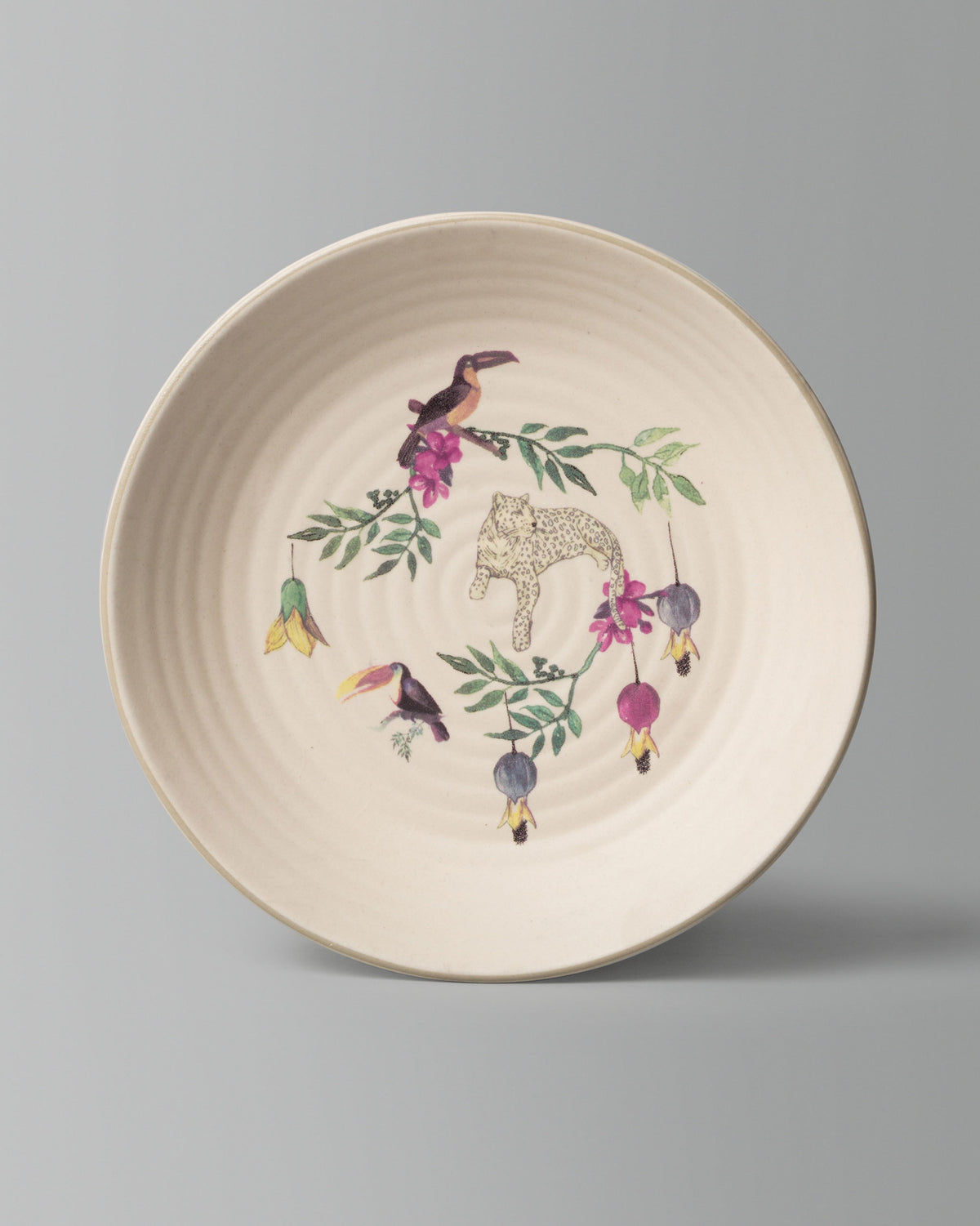
Nakano Pasta Plate
Listing says “Stoneware”
per kg of product, raw materials to the factory gate (weight not stated: add it under Change assumptions for a whole-life figure per item) · sold in India · made in India
Change anything below and the footprint recalculates. What you change is marked “Stated”. Nothing here is saved.
| Part | Material (kg CO₂e per kg) | Share % | Mass | Source |
|---|---|---|---|---|
| Material | Named material | 1,000 g | Estimated Primary source |
In everyday terms, about the same as driving 18 km in a petrol car, 388 smartphone charges, or 0.1 tree-years of absorption.
How this was calculated
Everything behind the figure, for auditors and the curious. Built to the requirements of ISO 14040/44, ISO 14067 and PACT v3.
Standards checkISO 14040/44, ISO 14067 and PACT v3, requirement by requirement
All 30 requirements, with clauses
| Requirement | ISO 14040/44 | ISO 14067 | PACT v3 |
|---|---|---|---|
| The study's purpose is written down | Met §4.2.2 | Met §6.3.1 | — |
| No public claim that one product beats another | Met §4.2.2; Amd 1 Annex C | Met §Annex A, Annex B | — |
| The unit is clear, and a partial footprint is labelled as such | Met §4.2.3.2 | Met §6.3.3 | Met §3.2.4 |
| The system boundary is described | Met §4.2.3.3 | Met §6.3.4, 7.3 b | Met §3.2.3 |
| The time period is stated and justified | — | Met §6.3.6 | Met §3.2.3 |
| Product category rules are used where they exist | — | Met §6.2 | Met §3.1.2 |
| Anything left out is small, estimated and reported | Met §4.2.3.3.3 | Met §6.3.4.3 | Met §3.3.1.2 |
| The data is checked for consistency | Met §4.3.2–4.3.3 | Met §6.4.3 | — |
| Own processes use measured data, or say why not | — | Not applicable §6.3.5 | Not applicable §4.1.3 |
| Every database value is referenced and fit for purpose | Met §4.3.2 | Met §6.3.5 | Met §4.1.3.2 |
| Shared factory burdens are split by the standard rules | Not applicable §4.3.4 | Not applicable §6.4.6 | Not applicable §3.3.1.4 |
| Recycling is counted with the cut-off method | Met §4.3.4.3 | Met §6.4.6.3 | Met §3.3.2.2 |
| Electricity covers its whole life cycle | Not applicable §4.3.2–4.3.3 | Not applicable §6.4.9.4.1 | Not applicable §3.3.2.3 |
| Electricity follows the market-based rules | — | Not applicable §6.4.9.4.4 | Not applicable §3.3.2.3, Box 7 |
| Land-use change is counted and shown separately | — | Not applicable §6.4.9.5 | Not applicable §3.3.2.4 |
| Biogenic carbon is counted in and out | — | Met §6.4.9.2, 6.4.9.3, 6.5.2 | Met §3.3.2.4 |
| Air freight is shown separately, without radiative forcing | — | Not applicable §6.4.9.7 | Not applicable §3.3.2.1 |
| No offsets or avoided emissions | — | Met §6.3.4.1 | Met §3.3.2.2 |
| Latest IPCC warming factors (AR6, 100 years) 100.0 % of cradle-to-gate emissions use AR5 factors; PACT allows only the latest IPCC report once its grace year has passed. Fix: Replace these factors with AR6-characterised data. | Justified §4.4.2 | Justified §6.5.1 | Not met §3.2.2 |
| Fossil and biogenic methane are kept apart | — | Met §6.5.2 | — |
| Key choices are stress-tested | Met §4.5.3.3 | Met §6.4.5, 6.6 | — |
| Uncertainty is assessed | — | Met §6.6 | — |
| Data quality is scored | Met §4.2.3.6 | Met §6.3.5 | Met §4.2.2, 4.2.3 |
| Limitations are stated | Met §4.5.4 | Met §6.6, Annex A | — |
| Results are broken down the required way | — | Met §7.2 | Met §3.3.1, data model |
| The study report contains every required item | Met §5.2 | Met §7.3 | — |
| The PACT data file is complete Missing or invalid: companyIds, productIds. Fix: Add company and product identifiers (URNs such as urn:mfp:company:acme), the reference period and a PACT unit. | — | — | Not met §6.1; Tech Specs v3.0.3 |
| The primary data share is reported | — | — | Met §4.2.2 |
| Independent critical review No critical review recorded. Fix: Commission an ISO 14071 critical review before any public communication; a panel review is mandatory for public comparisons. | Needs reviewer §6 | Needs reviewer §8 | — |
| Third-party verification of the calculation model The MFP footprint calculation model has not yet been verified by a third party. Fix: Commission limited-assurance verification of the calculation model (PACT v3 §5.3.3, Tables 14–15). | — | — | Needs reviewer §5.3.3 |
These standards apply to studies. This checklist reports the implemented checks; it is not certification or a substitute for independent review. “Needs reviewer” items (critical review, verification of the calculation model) can only be closed by an independent third party.
Assumptions and defaults11 entries
Assumptions register · 11 entries
- Screening mode: this listing gives no primary data, so every input below that is not a stated material or weight is a named screening default. The result is not PACT-conformant (primary data share 0 %).
- The listing states no weight and no typical weight is on file for "plate / platter", so the footprint is given per kilogram of product (ISO 14067 declared unit). Enter the product's weight for a per-item figure.
- Country of manufacture not stated in the listing; India assumed.
- m1: material share 100 % is estimated from the listing text.
- Packaging is not stated and no verified default exists for plate / platter, so it is excluded.
- Making the product: glazing and firing are inside the tableware factor.
- Inbound transport of materials to the factory is left out of the total, because supplier locations are unknown; its likely size is estimated and reported under the cut-off rule below.
- Distribution route is a screening default (1,000 km road), carrying product plus packaging.
- Cut-off rule: processes are excluded only where no verified data exists, and each exclusion is estimated where possible and reported (ISO 14044 §4.2.3.3.3). Inbound transport is estimated at 0.0626 kg CO₂e.
- Aggregated secondary factors are used as published in their own GWP basis (AR5); only gas-split fuel factors and direct gas emissions are characterised with AR6. Residual inconsistency is typically a few percent for CO2-dominated factors.
- Sources quoted as published figures (not open-licensed datasets): zelezny_2023. Replace with licensed or supplier data before external or comparative claims.
SensitivityThe figure with other published choices
The footprint recalculated with each alternative choice: other published factors, the other allocation method, the grid mix instead of a green-power contract, and the use profile at its uncertainty bounds. A large change shows where better data pays off first.
| Line | Choice tested | Baseline | Alternative | Δ kg CO₂e | Δ % |
|---|---|---|---|---|---|
| Ceramic / stoneware | Emission factor | Ceramic tableware, wheel-thrown studio stoneware, electric kiln 1280 °C | Porcelain tableware (Bonna EPD, A1-A3) EPD-IES-0017302:003, 'Print, Ground, Cras Collection', Kar Porselen Sanayi ve Ticaret A.S. (Bonna), International EPD System, PCR 2022:01 Tableware and kitchenware v1.0; ecoinvent 3.11, SimaPro 10.2; version 2025-12-05, valid to 2030-12-04 | -0.390 | -12.6% |
| Ceramic / stoneware | Emission factor | Ceramic tableware, wheel-thrown studio stoneware, electric kiln 1280 °C | Porcelain tableware, factory production Zelezny A., Kulhanek J., Pesta J., Koci V. (2023) 'LCA Case Study of Ceramic Tableware: Ecodesign Aspects of Ceramics Production from Ancient Technology to Present Factory', Sustainability 15(11):9097, doi:10.3390/su15119097 (GaBi + ecoinve | +0.540 | +17.4% |
Every line of the calculation1 lines: activity × factor, with sources
Footprint = Σ activity × emission factor
Every line: how much (activity) × how much CO₂e per unit (factor), with its source. Source labels
| Stage | Line | Activity | × Factor | = kg CO₂e | DQR | Source |
|---|---|---|---|---|---|---|
| Raw materials | Ceramic / stoneware ceramic_stoneware (virgin) | 1.000 kg | 3.1 kg/kg | 3.100 | 3/5/5 Very low · +307% | Primary source Zelezny et al. (2023) Sustainability 15(11):9097, Table 2 database · 2023 |
| Total, excluding biogenic uptake | 3.100 |
ISO 14067 study reportSeparately reported values and report contents
ISO 14067 study report · partial carbon footprint (cradle-to-gate, declared unit)
| Footprint per 1 kg (ISO 14067, incl. biogenic −1/+1) | 3.1000 kg CO₂e |
| Net fossil GHG | 3.1000 kg CO₂e |
| Biogenic CO₂ emissions | 0.0000 kg CO₂ |
| Biogenic CO₂ removals | 0.0000 kg CO₂ |
| Biogenic CH₄ (as CO₂e) | 0.0000 kg CO₂e |
| Direct land-use change | 0.0000 kg CO₂e |
| Aircraft (no radiative forcing) | 0.0000 kg CO₂e |
| Biogenic carbon content | 0.0000 kg C |
| Outbound logistics (reported separately) | 0.0000 kg CO₂e |
| Raw materials | 3.1000 kg · 100% |
| Production | 0.0000 kg · 0% |
| Inbound transport | 0.0000 kg · 0% |
| Packaging | 0.0000 kg · 0% |
| Goal: application, reasons, audience, comparative assertion §6.3.1 / 14044 4.2.2 | Screening carbon footprint shown on the Made for Planet catalogue so brands and buyers can see where a product's emissions come from. Reasons: No company data is available for this listing; a transparent estimate from the listing and published factors shows the likely size and the main stages. Audience: Brands and buyers (business-to-business). The estimate is also displayed on madeforplanet.com, labelled as a screening estimate; it is not an environmental claim the brand may use in marketing. Public comparative assertion: no. |
| Functional or declared unit and reference flow §7.3 a | Declared unit: 1 kg (partial carbon footprint); reference flow 1 kg of product. |
| System boundary §7.3 b | cradle to gate. Screening partial carbon footprint, cradle to gate, per kg: materials and packaging where known. Distribution, use and end of life are outside the boundary. Capital goods are excluded, as is usual for attributional product footprints. Stages modelled: raw_materials. |
| Significant unit processes §7.3 c | ceramic_stoneware (virgin) (100 %) |
| Data sources §7.3 d | Zelezny et al. (2023) LCA case study of ceramic tableware, Sustainability 15:9097 2023 |
| Greenhouse gases considered §7.3 e | CO₂, CH₄ (fossil and biogenic), N₂O and refrigerant gases (HFCs, SF₆, NF₃) where present; secondary factors cover the gases their publishers include. |
| Characterisation factors §7.3 f | IPCC AR6 GWP100 with climate-carbon feedbacks; secondary factors in their published basis where no AR6 version exists (see gwp check). |
| Cut-off criteria and exclusions §7.3 g, o | Inbound transport of materials to the factory: 0.06261 kg CO₂e (screening estimate: 1.000 kg of materials × 500 km by average lorry (UK DESNZ GHG conversion factors 2025, Freighting goods + WTT delivery vehicles); supplier locations are not known) |
| Allocation procedures §7.3 h | No multi-output processes. Recycling: cut-off. |
| Timing of emissions §7.3 i, 6.4.8 | All emissions and removals counted as at the start of the assessment period; no delayed-emission weighting. |
| Data description and quality §7.3 j | PACT Table 12 DQR: technological 3, geographical 5, temporal 5; per-line scores, confidence and 95 % uncertainty in the inventory. |
| Sensitivity and uncertainty §7.3 k | 2 sensitivity case(s); lognormal Monte Carlo on pedigree uncertainty. |
| Electricity treatment §7.3 l | No electricity in scope. |
| Interpretation, limitations §7.3 m, Annex A | Climate change only: other impacts (water, land, toxicity, biodiversity) are not assessed, so a lower footprint does not mean a lower environmental impact overall. Secondary factors limit accuracy as shown by the data-quality scores. |
| Value choices §7.3 n | Cut-off for recycling (PACT); economic allocation only above a 5× value ratio; conservative factor where published values disagree (see sensitivity). |
| Scope changes and exclusions §7.3 o | No product weight is stated, so the study is a partial carbon footprint per kg of product (cradle to gate): distribution, use and end of life are not quantified (ISO 14067 §6.3.3). Packaging is not stated and no verified default exists for this kind of product, so it is excluded without an estimate. |
| Life-cycle stages, use and end-of-life scenarios §7.3 p, 6.3.7, 6.3.8 | Not in scope (partial carbon footprint, cradle-to-gate). |
| Influence of alternative scenarios §7.3 q | factor_choice m1: -12.6 %; factor_choice m1: 17.4 % |
| Period the footprint represents §7.3 r, 6.3.6 | 2026-01-01 to 2026-12-31: current production as represented by the factor library (each factor's own data year is scored in the temporal data quality) |
| Product category rules §7.3 s, 6.2 | No product category rules conforming to ISO/TS 14027 are known for this product category; MFP screening rules are applied and disclosed. |
| Performance tracking §7.3 t, 6.4.7 | Not a performance-tracking study. |
ISO 14067 counts biogenic removals (−1) and emissions (+1) in the carbon footprint; the PACT headline excludes biogenic uptake. Both are shown.
PACT v3 data and biogenic carbonData-exchange values and a downloadable file
PACT v3 data model (cradle-to-gate) and biogenic carbon balance
Download PACT v3.0.3 JSON ProductFootprint in the Technical Specifications v3.0.3 format (decimals as strings). Check the conformance panel before sending it.
| Footprint excl. biogenic uptake | 3.1000 kg CO₂e |
| Footprint incl. biogenic uptake | 3.1000 kg CO₂e |
| Fossil GHG emissions | 3.1000 kg CO₂e |
| Land-use change GHG | 0.0000 kg CO₂e |
| Biogenic non-CO₂ | 0.0000 kg CO₂e |
| Biogenic CO₂ uptake | 0.0000 kg CO₂ |
| Fossil carbon content | 0.0000 kg C |
| Biogenic carbon content | 0.0000 kg C |
| Aircraft GHG (no RF) | 0.0000 kg CO₂e |
| Packaging GHG | 0.0000 kg CO₂e |
| Exempted emissions | 1.9800 % |
| Primary data share | 0.0000 % |
| IPCC characterisation | AR6, AR5 |
| Biogenic CO₂ uptake | 0.0000 kg CO₂ |
| Biogenic CO₂ emitted | 0.0000 kg CO₂ |
| Biogenic C stored in landfill | 0.0000 kg C |
| Biogenic C exported to recycling | 0.0000 kg C |
| Biogenic C in product | 0.0000 kg C |
| Engine / factor library | 1.2.0 / 2026.11-mfp.8 |